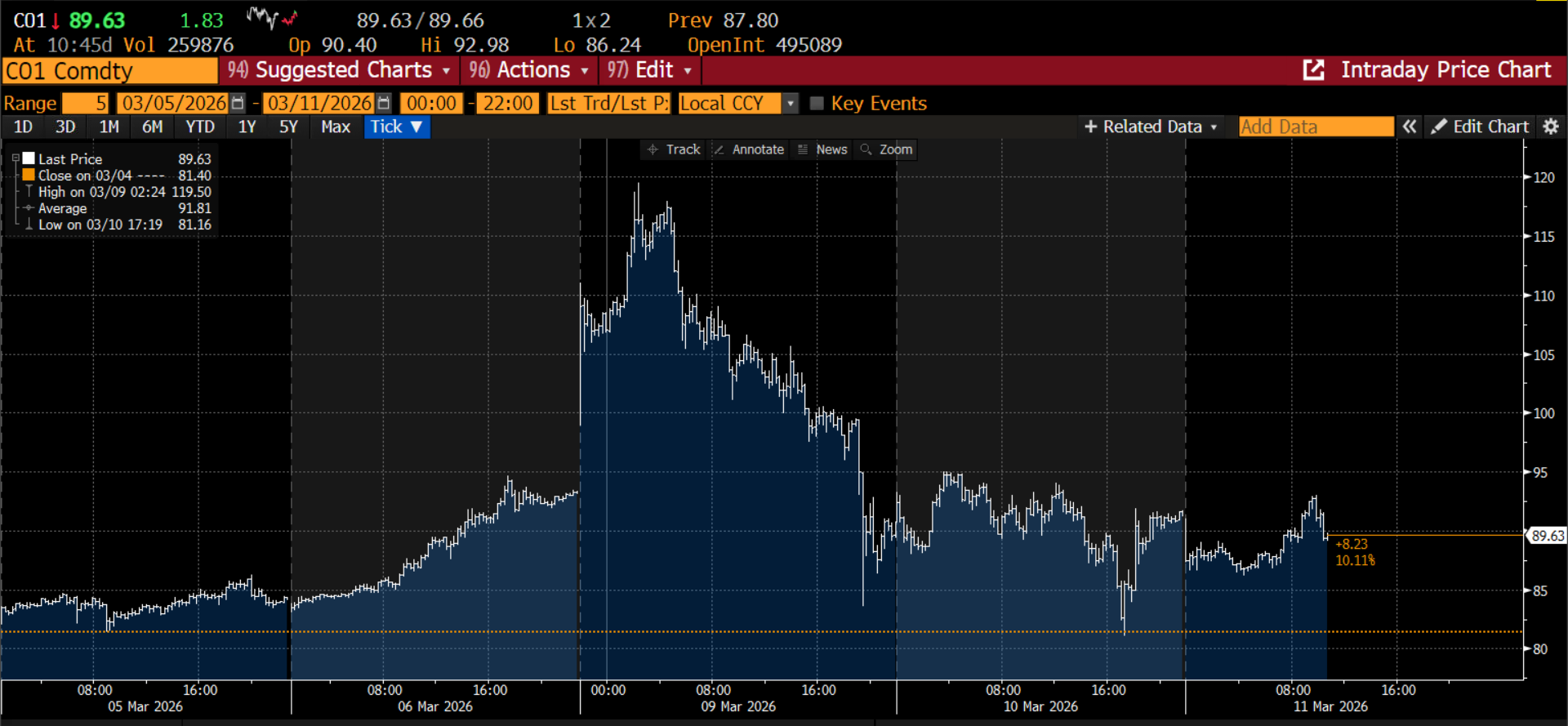
We are living through a period of high volatility right now. Stocks are back in the red, bonds are selling off once more and the oil price is higher by another 3%, although it has backed away from earlier highs. This back and forth across major asset markets is a keen reminder that the war between Iran and the US/ Israel is still ongoing, and until that is resolved, there will be no single narrative that drives markets. For now, headlines are king, markets are reactive, and news that cargo ships in the Strait of Hormuz have been attacked is keeping a floor on the oil price.
Reserve release to free up flow of oil may not have big impact on prices
Global policy makers are coordinating action to try and keep oil flowing around the world. They will not allow Iran to take the global economy hostage by threatening the Strait of Hormuz. Their latest step to cushion the impact of the war on oil prices is the release of 300-400mn barrels from the International Energy Agency’s strategic oil reserve. This has not had a limited effect on the price of oil so far, and Brent crude is still above $90 per barrel.
The expectation is that the releasee of IEA reserves could increase the flow of oil and oil products by 4 million barrels per day for next few weeks. The US holds mostly crude, Europe holds mostly products in reserve and Japan holds a mix, thus, the reserve release will not be able to replace all of the energy production in the Gulf that has been suspended due to facilities damaged by Iranian drones.
Added to this, the last time there was a coordinated release of strategic reserves, back in 2022, it did not have a dampening effect on the oil price, which kept rising. Even though more reserves have been released compared to 2022, there is still a high bar for the market to start selling oil to ease upward pressure on the price.
ECB rate hike now expected in 2026
The knock-on effect from the spike in oil prices, the Brent crude price has risen 26% so far in March and by 50% so far this year, is a recalibration in monetary policy expectations. This is front and centre on Wednesday, after the ECB’s Kazimer said that a rate hike on the back of events in Iran could be ‘closer than thought’. The market has immediately rushed to price in a hike, there is now 1.3 rate hikes priced in for the ECB by the end of this year, yesterday the market was still pricing in the small prospect of a cut by next year.
In the UK, Gilt yields are marching higher once more, and the 10-year Gilt yield is higher by 8bps. Although a rate hike from the BOE is not expected this year, there are only 5bps of cuts priced in by the interest rate futures market, so a hike cannot be ruled out if the oi price remains elevated for long.
No clear direction for stocks
Interest rate futures volatility is unpreceded, which has a knock on effect for business and household confidence, inflation expectations and the economy. It is no wonder that stocks are selling off once more on Wednesday and it is why equities are having a hard time trying to maintain a rally today, as industrial and consumer stocks struggle once more.
If the Strait of Hormuz continues to be unpassable, then it won’t just be petrol prices at the pump that are going up. Key inputs like fertilizer, food and industrial inputs are also at risk. Interestingly, the price of agricultural commodities has also risen sharply this month, with a near 20% increase in the price of cocoa, 5% increase for coffee and a 5% gain for wheat.
Oil price remains king for sentiment, as we wait for US CPI
This week’s price action shows us two things, that market trends are not holding for long, especially if they are linked to a recovery in risky asset prices, and that policy makers only have so much sway on the oil price, which remains central to the global financial markets right now.
Later today, US CPI for February will be released. This seems woefully out of date right now, however, it is still worth watching. If headline inflation is weaker than the 2.4% expected, it would suggest that US price growth was in a more favourable place before the oil price spike, which could cushion the economic blow from the war in the Middle East.
Chart 1: The oil price over the last 5 days
Source: XTB and Bloomberg
The material on this page does not constitute financial advice and does not take into account your level of understanding, investment objectives, financial situation or any other specific needs. All information provided, including opinions, market research, mathematical results and technical analyzes published on the Website or transmitted To you by other means, it is provided for information purposes only and should in no way be construed as an offer or solicitation for a transaction in any financial instrument, nor should the information provided be construed as advice of a legal or financial nature on which any investment decisions you make should be based exclusively To your level of understanding, investment objectives, financial situation, or other specific needs, any decision to act on the information published on the Website or sent to you by other means is entirely at your own risk if you In doubt or unsure about your understanding of a particular product, instrument, service or transaction, you should seek professional or legal advice before trading. Investing in CFDs carries a high level of risk, as they are leveraged products and have small movements Often the market can result in much larger movements in the value of your investment, and this can work against you or in your favor. Please ensure you fully understand the risks involved, taking into account investments objectives and level of experience, before trading and, if necessary, seek independent advice.