U.S. Iran and Israel – What do we Know and What May Happen

The conflict that erupted on February 28, 2026, has entered a phase that could be described as “diplomacy under fire.” With one hand, Washington is sending a 15-point peace plan, while with the other, it is deploying thousands more troops to the region. Operation “Epic Fury,” a joint U.S.-Israeli strike against Iran, led to the death of Supreme Leader Ali Khamenei and triggered a cascade of events whose economic and geopolitical consequences continue to shake global markets to this day.
Trump’s 15-point plan
The Trump administration has delivered a 15-point document to Tehran via Pakistan, intended to serve as the basis for a ceasefire and a potential agreement to end the war. The plan requires Iran to dismantle its nuclear capabilities, permanently cease uranium enrichment, and place its existing stockpiles of enriched material under IAEA control. Tehran would also have to cease funding and arming regional proxies, such as Hezbollah, the Houthis, and others, and guarantee freedom of navigation through the Strait of Hormuz. In return, Washington offers the complete lifting of sanctions and assistance in building a civilian nuclear program based on the Bushehr power plant. Trump simultaneously announced a 5-day suspension of threats of attacks on Iranian energy infrastructure, allowing time for talks. Special envoys Steve Witkoff and Jared Kushner, Secretary of State Marco Rubio, and Vice President JD Vance are involved.
Tehran’s Response: Words vs. Actions
Iran publicly rejects direct negotiations. The Iranian armed forces issued a statement mocking Washington, saying: “The level of your internal conflicts has reached a point where you are negotiating with yourselves.” Tehran has appointed Mohammad-Bagher Zolghadr, a veteran of the Islamic Revolutionary Guard Corps, as the new head of national security—a man with little diplomatic experience. At the same time, Iran maintains that it will not restore normal oil and energy prices until “all threats to the country have been completely eliminated.” Significantly, however, Tehran has informed the International Maritime Organization that foreign ships may transit the Strait of Hormuz provided they do not support “acts of aggression” and comply with Iranian regulations. This is a small gesture of goodwill, though Iran has already begun collecting transit fees from commercial vessels passing through, demonstrating effective control over the strait.
Markets: Relief, but Not Peace of Mind
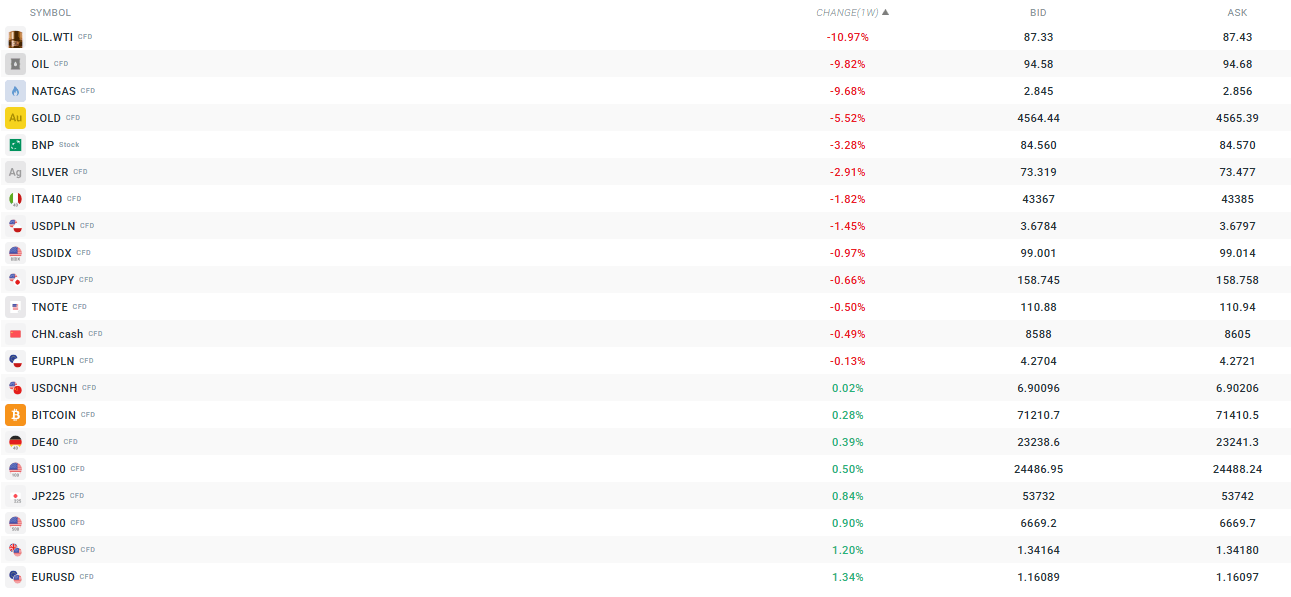
The latest news has triggered significant portfolio rebalancing across most major contracts. Brent fell by as much as 10% over the week, reaching a level close to $95 per barrel, while WTI hovered near $88, as markets reacted positively to diplomatic signals and the suspension of threats against energy infrastructure. S&P 500 futures rose by 0.9%. The dollar weakened relatively slightly, and the Bloomberg index for the U.S. currency lost 0.95%.
In the longer term, however, risks remain. Gasoline prices in the U.S. have risen every day since the conflict erupted, and in California, a gallon of fuel costs the equivalent of nearly $6, which is one of the highest levels in history. Chevron has explicitly warned that California could face an energy crisis if the situation in the Strait of Hormuz does not change.
The Threat of Military Escalation
At the same time, the Pentagon is deploying additional military forces: approximately 2,000 troops from the 82nd Airborne Division have been sent to the region, and Marines are also already on their way. Bloomberg Economics has identified five potential scenarios for the use of ground forces: seizing the island of Charg—Iran’s main oil export terminal—as a bargaining chip, quarantining the island, neutralizing Iranian threats to the strait, escorting ships, or seizing Iran’s stockpiles of enriched uranium. Each of these scenarios carries significant risks—ranging from “high” to “very high”—and would involve the use of advanced equipment from companies such as Lockheed Martin, RTX, Boeing, Northrop Grumman, BAE Systems, and L3Harris. The seizure of Charg would be particularly risky: it would require an amphibious landing by the Marines, an airborne assault by the 82nd Division, and the prolonged holding of the island under Iranian retaliatory fire. The scenario of seizing Iranian uranium—estimated at 441 kilograms of material capable of producing about a dozen nuclear warheads—would, in turn, be a special operations mission deep inside enemy territory.
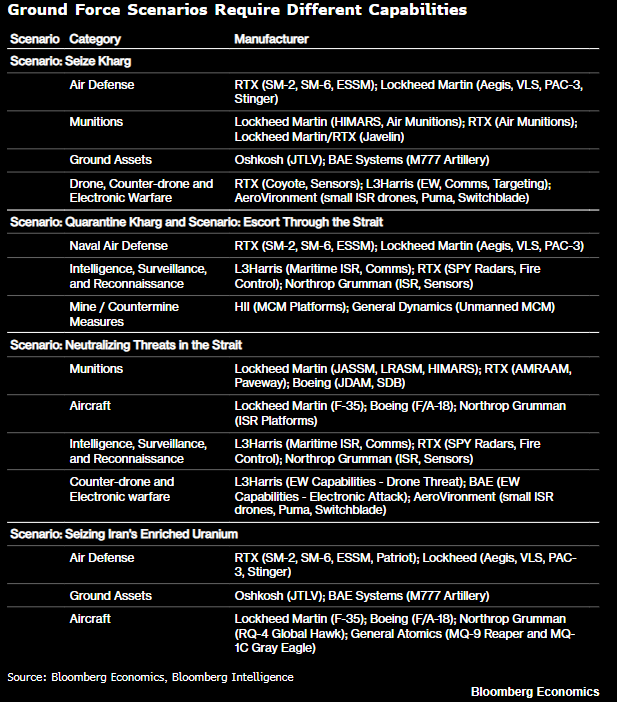
Source: Bloomberg Financial Lp
Geopolitical chess
Paradoxically, Saudi Arabia is pushing for the war to continue, and Crown Prince Mohammed bin Salman reportedly tried to convince Trump that this is a historic opportunity to reshape the regional order. India and China are calling for the strait to be opened, as the Iranian energy hub is of critical importance to both countries. Pakistan has offered to act as a mediator, and Trump even shared Prime Minister Sharif’s tweet on his profile, though he has not officially confirmed this role. Israel, meanwhile, has no intention of halting its strikes. Defense Minister Katz announced the continuation of the campaign “with full intensity.”
What’s next?
Markets are currently pinning their hopes on a pause in hostilities, but a five-day suspension of threats against energy targets is not enough to rebuild lasting trust. The key question is: Is Iran ready to sit down for talks from a position of strength, or is it merely playing for time to regroup and reorganize its command structure following losses to its nuclear and military infrastructure? The appointment of Zolghadar to head national security suggests the latter. If diplomacy fails and Trump decides to deploy ground forces, particularly in a scenario involving the capture of Kharg, oil prices could quickly rise above $100, and regional escalation could draw additional players into the conflict, from Saudi Arabia to Lebanon.
The material on this page does not constitute financial advice and does not take into account your level of understanding, investment objectives, financial situation or any other specific needs. All information provided, including opinions, market research, mathematical results and technical analyzes published on the Website or transmitted To you by other means, it is provided for information purposes only and should in no way be construed as an offer or solicitation for a transaction in any financial instrument, nor should the information provided be construed as advice of a legal or financial nature on which any investment decisions you make should be based exclusively To your level of understanding, investment objectives, financial situation, or other specific needs, any decision to act on the information published on the Website or sent to you by other means is entirely at your own risk if you In doubt or unsure about your understanding of a particular product, instrument, service or transaction, you should seek professional or legal advice before trading. Investing in CFDs carries a high level of risk, as they are leveraged products and have small movements Often the market can result in much larger movements in the value of your investment, and this can work against you or in your favor. Please ensure you fully understand the risks involved, taking into account investments objectives and level of experience, before trading and, if necessary, seek independent advice.