It’s been a very quiet lead up to the Chancellor’s Spring Statement that is due on 3rd March at 1230 GMT. In contrast to the months of speculation surrounding last November’s Budget, there has been no fevered speculation about tax and spend changes. This is to be expected; Chancellor Rachel Reeves had made clear that she wants only one fiscal update a year and the spring statement is a formality rather than a political and economic event.
Unemployment forecast set to rise, but could a growth upgrade be on the cards?
Instead, the OBR will deliver their updated forecasts for growth and the public finances. These are expected to be mixed. The unemployment rate is expected to be revised higher. In its previous forecast, the OBR expected the unemployment rate to hover around 5% through to 2027. However, the unemployment rate rose to 5.2% in the final quarter of last year, and the UK’s youth unemployment rate surged above the EU’s level for the first time, it now stands at 15.3%.
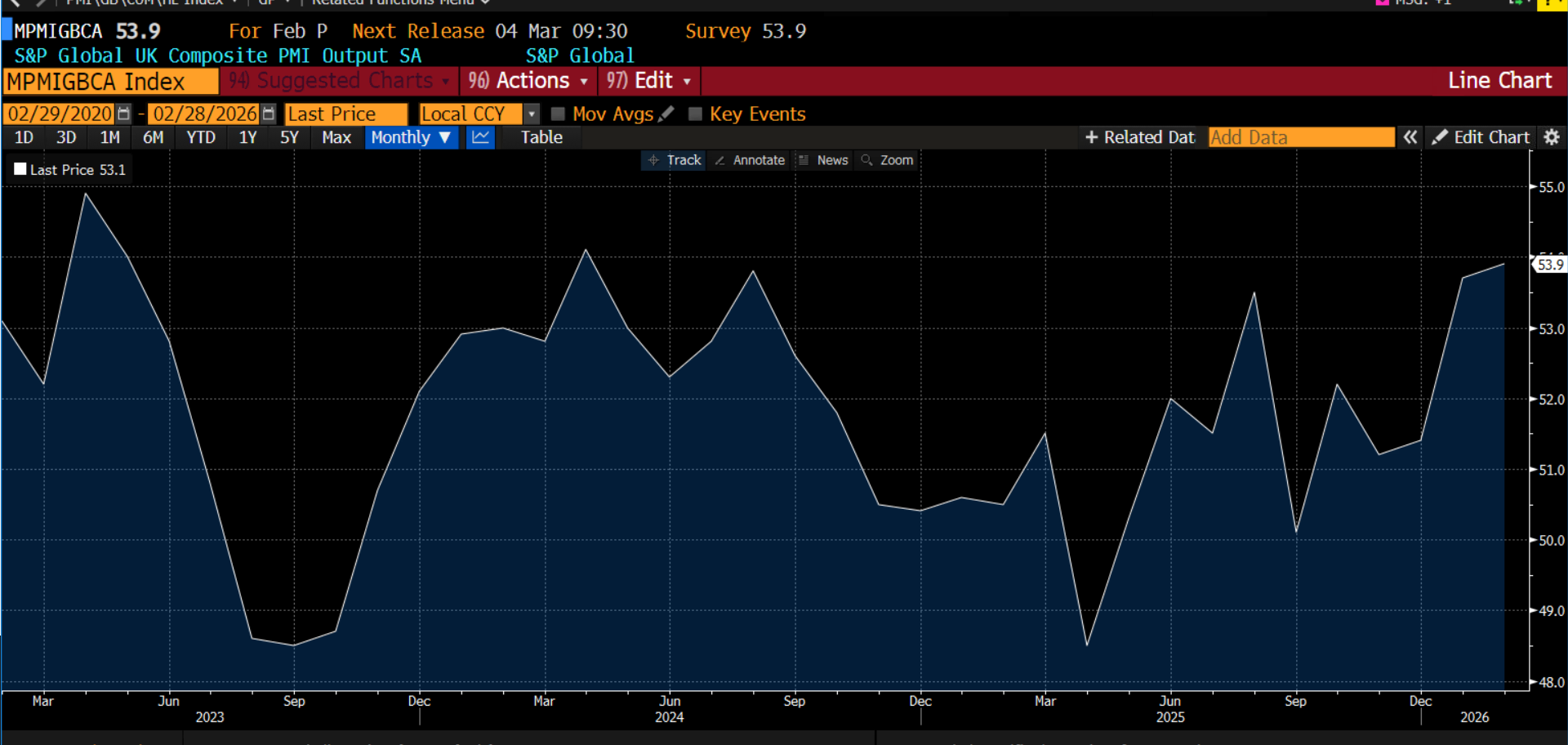
Expectations are rising that the OBR will downgrade last year’s growth forecast to 1.1% from 1.3%, after a sluggish second half of the year. However, growth has picked up sharply in 2026, and the composite PMI suggests that the post-budget period saw a strong performance for the private sector. The composite PMI rose to 53.9 this month, the highest level since April 2024. Thus, there could be a growth upgrade for 2026 to sweeten the blow of a weaker 2025.
Chart 1: UK composite PMI
Source: XTB and Bloomberg
Other potential positive adjustments in the OBR forecasts include inflation falling back to the 2% target this spring, and there could be an upgrade to productivity, which had been revised down by the OBR previously to 1% from 1.3%. Partly this will be a result of the rising unemployment rate, but if the OBR points out real productivity gains from the adoption of AI and other technological advances, then this may lend some hope that 2026 will be the year when the UK’s economy recovers from its malaise.
OBR to give Fiscal Boost
Perhaps the best news will come from the fiscal forecasts. Last November, the OBR saw fiscal headroom of £21.7bn. This is expected to be maintained, after the UK posted a record-breaking budget surplus of £30.4bn, driven by self-assessment tax returns and CGT receipts. Added to this, the UK’s debt servicing costs were £4bn below OBR estimates. Day to day central government spending dropped by 0.7% compared to a year ago, and public sector net borrowing was also lower by 11.5% compared to 2024.
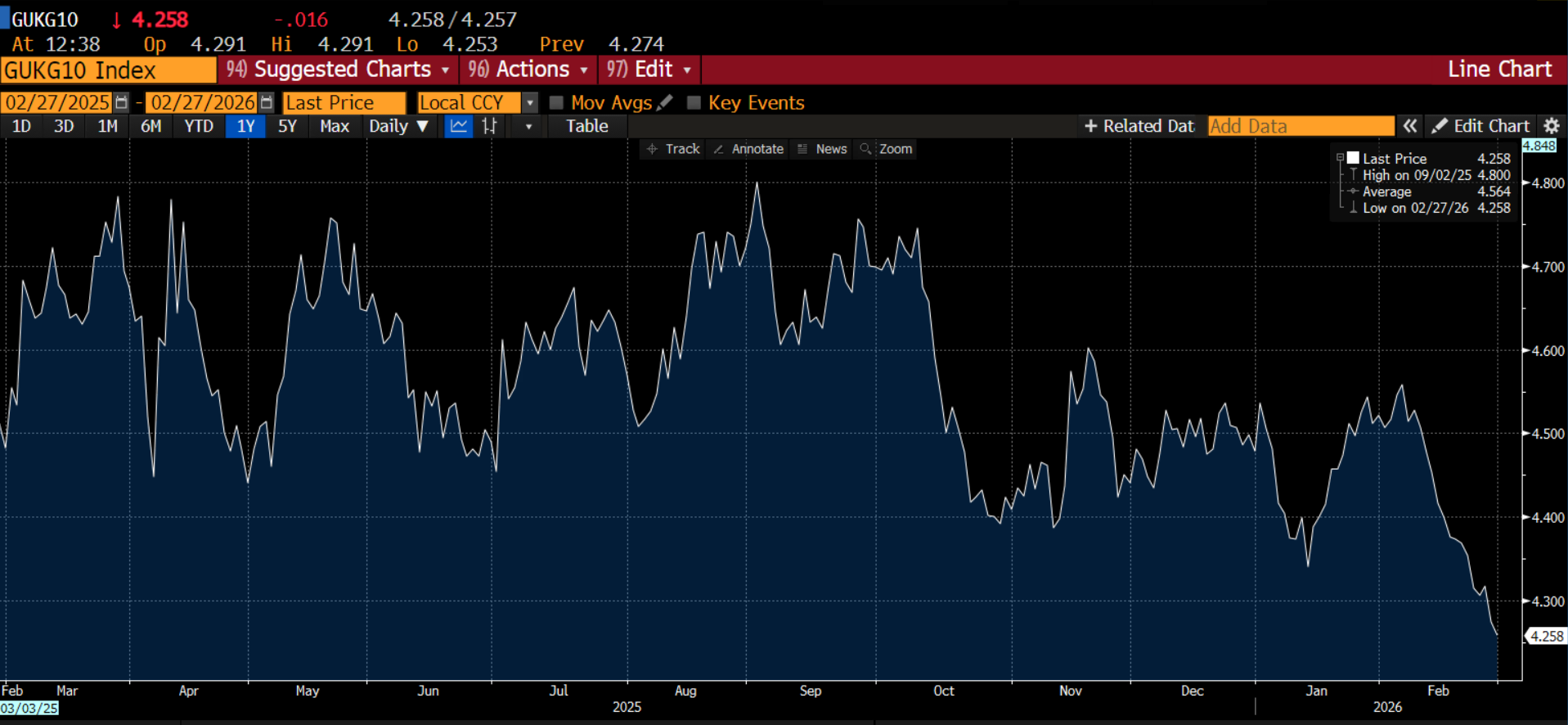
Gilt sales for the 2026/27 fiscal year are expected to be slashed by 20% to £245bn, the lowest level for 3 years. An improved fiscal picture is one reason why the UK bond market is a top performer globally this month, and 10-year Gilt yields are lower by 26bps. At 4.25%, the UK 10-year Gilt yield is at its lowest level for over a year.
UK bond market boosted by fiscal improvement, and more resilient to political risks
The improved fiscal picture has built a resilience in the UK bond market to political risks. The political risk premium is lower for UK bonds even though Labour had a disastrous showing at the Dorton and Garton byelection yesterday. While it looks less likely that Starmer will be pushed out as PM, a better fiscal position combined with expectations that the UK’s budget deficit will fall to 3.6% of GDP, is the chief reason, in our view, why the UK’s bond market is recovering so far this year.
Chart 2: UK 10-year Gilt yield
Source: XTB and Bloomberg
While we do not expect any tax changes or spending pledges in the Spring Statement, there has been a lot of publicity about the UK’s unfair student loan system and a push by the PM to boost defense spending to 2.5% of GDP by next April. Committing to defense spending at this level and making the student loans system fairer will require spending commitments, and it will be interesting to see how Reeves addresses these concerns in her statement.
Could OBR burst Rachel Reeves’ bubble
Another topic that is gaining traction as we lead up to the spring statement is a sharp fall in migration and the negative impact that this may have on tax returns. Rachel Reeves will most likely want to focus on the positive improvement to the UK’s fiscal position in recent months, however, if the OBR suggests that this is a one off, then UK Gilts may no longer be flavour of the month.
Overall, if this event is as low-key as Rachel Reeves hopes, then we do not expect a large market reaction. But, if the OBR forecasts paint a bleak picture of the UK economy where unemployment is rising and the tax take is falling, then sterling and Gilts will be vulnerable.
The material on this page does not constitute financial advice and does not take into account your level of understanding, investment objectives, financial situation or any other specific needs. All information provided, including opinions, market research, mathematical results and technical analyzes published on the Website or transmitted To you by other means, it is provided for information purposes only and should in no way be construed as an offer or solicitation for a transaction in any financial instrument, nor should the information provided be construed as advice of a legal or financial nature on which any investment decisions you make should be based exclusively To your level of understanding, investment objectives, financial situation, or other specific needs, any decision to act on the information published on the Website or sent to you by other means is entirely at your own risk if you In doubt or unsure about your understanding of a particular product, instrument, service or transaction, you should seek professional or legal advice before trading. Investing in CFDs carries a high level of risk, as they are leveraged products and have small movements Often the market can result in much larger movements in the value of your investment, and this can work against you or in your favor. Please ensure you fully understand the risks involved, taking into account investments objectives and level of experience, before trading and, if necessary, seek independent advice.