As we move through the day on Monday, the Middle East conflict continues to dominate. The effects are broad-based across markets, but the biggest impact has been on energy prices and the sovereign bond market.
Sovereign bonds sell off sharply
Far from acting as havens, sovereign bonds have sold off sharply and 10-year Gilt yields are higher by 6bps in the UK, 7bps in France and 8bps in Italy. US Treasury yields are also higher by 8bps so far today, and Canada is also facing sharply higher yields. Fears that a large spike in energy prices will cause another wave of inflation around the world is the latest macro risk emanating from the conflict.
Why we may not get a traditional oil price shock
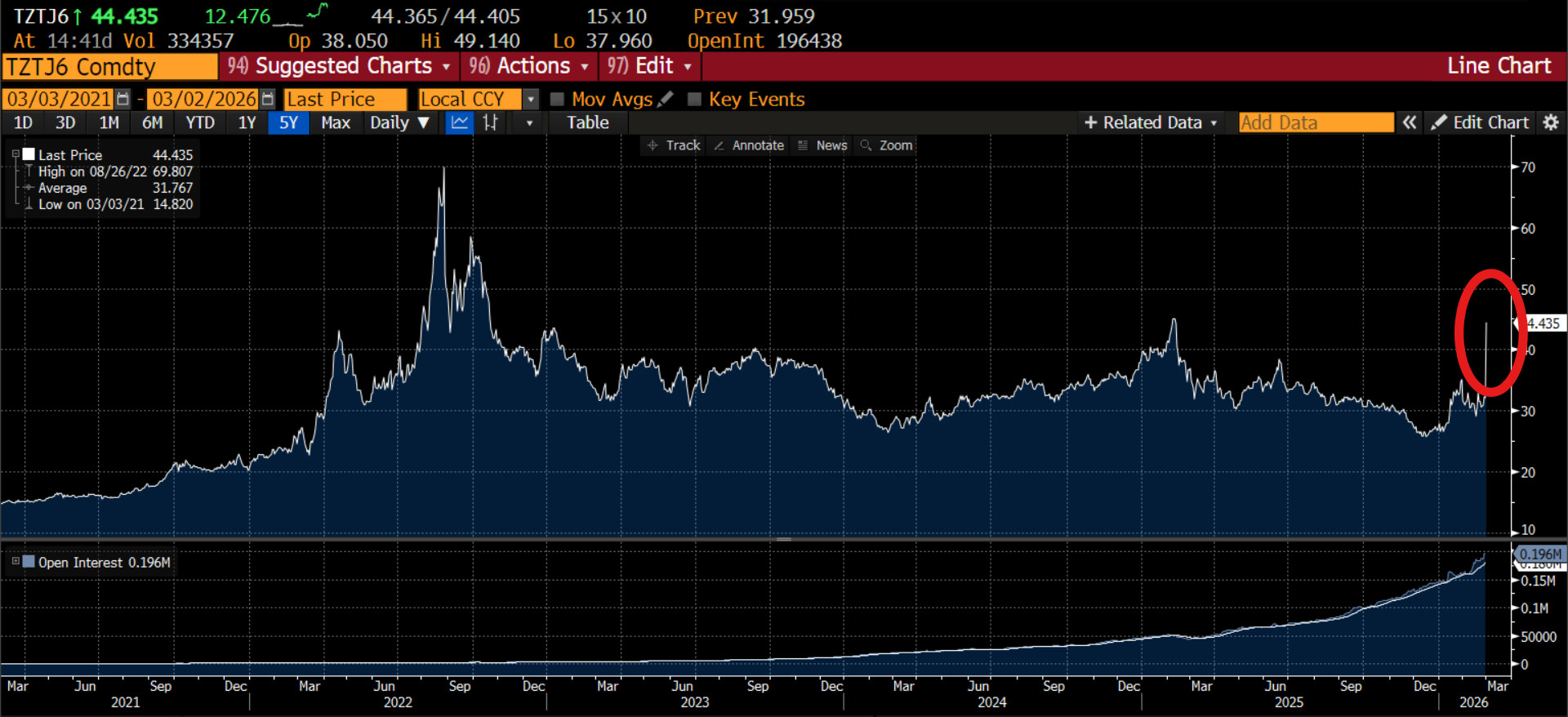
The oil price is higher by more than 7% so far on Monday, but Brent crude remains below the key $80 per barrel level. So far, this conflict has not caused $100 per barrel oil, and we may not get the traditional ‘oil price shock’. However, fears are elevated about the gas price. Nat gas prices have surged today, and are currently up approx. 50%, after Qatar said that it was suspending LNG production due to Iranian drone strikes.
Europe at risk from Nat Gas spike
Natural gas is a major part of our energy mix in Europe, and 80%-90% of the continent’s supply is imported. LNG imports from Qatar account for 10% to 15% of Europe’s total gas imports, which means that Europe will need to look elsewhere for gas supplies in the short term. This is putting a huge premium on Nat Gas prices, which are traditionally volatile during periods of heightened risk aversion.
BOE cuts rapidly scaled back after spike in gas price
Today’s move in the gas market suggests that the conflict in the Middle East could have broad macro implications for the global economy. The spike in energy costs risks ending the period of disinflation in Europe and the US, which has helped to boost economic prospects on both sides of the Atlantic. It also threatens future interest rates cuts, especially for the Bank of England. Last week there was a more than 80% chance of a cut at this month’s BOE meeting, that has now fallen back to less than 50%. There are now only 1.7 cuts expected from the BOE this year, as investors fear a 2022-style inflation crisis for the UK.
Why the nat gas price spike may be overdone
There are some reasons to be optimistic about this. Firstly, the ‘moderate’ rise in the oil price is a sign that the market is well supplied with oil right now, which could have a dampening impact on markets. Secondly, we are coming out of winter in Europe, so energy needs are slightly less than they would have been two months ago. Lastly, but most importantly, we doubt that Qatar will suspend LNG production for long as it is its main export and it is reliant on LNG revenues.
The markets are in a reactionary mood, and price action is driven by headlines for now. If Qatar’s LNG production comes back online in the near term, then we could see the Nat Gas price start to moderate.
Chart 1: Nat Gas price spike
Source: XTB and Bloomberg
Equity market losses look moderate so far, but airlines tank
As markets open in the US, risk sentiment remains fragile, and stocks are in the red across Europe. The FTSE 100 is proving to be the most resilient, and is lower by 1.5% so far on Monday, compared to a 2.5% decline for the Eurostoxx index. Stock market movements look moderate compared to price moves in sovereign bond yields and in the energy market, which is where the bulk of the action is at the moment.
Fears about an inflation spike and rising prices is likely to weigh on consumer stocks. Airlines and hotels are already down sharply as Middle Eastern airspace remains closed. Air France KLM is lower by 9% so far on Monday, and IAG group, the parent company of British Airways, is down more than 5%, although it has clawed back some previous losses.
Will the Buy America trade come back?
It is worth watching how the market reaction in the US evolves today. Will the US underperformance continue, even though the US economy is better protected from an oil price shock compared to Europe? Also, a spike in the oil price is good news for the wealth of the world’s largest oil producer: the US, which pumps more than 17mn barrels of oil a day.
The performance for tech stocks is mixed at this early stage. On the one hand, AI/ defense names like Palantir are sharply higher, its share price is up by 5% as its tech is crucial for the US military’s actions in Iran. Stocks in the US are paring losses at the open, and the Nasdaq is down by less than 1%, the S&P 500 is lower by 0.7%. European stocks have outperformed the US in recent weeks, however, the reliance of European industry and businesses on energy imports leaves them vulnerable in this environment, so we may see some US stock market outperformance for the duration of this conflict.
As we have mentioned, this is a fluid situation, and things are changing quickly. The potential negative macro effects from this conflict are now being priced in by the market, but prices will move based on headlines. Thus, for now, expect sharp price swings and the energy market is king.
The material on this page does not constitute financial advice and does not take into account your level of understanding, investment objectives, financial situation or any other specific needs. All information provided, including opinions, market research, mathematical results and technical analyzes published on the Website or transmitted To you by other means, it is provided for information purposes only and should in no way be construed as an offer or solicitation for a transaction in any financial instrument, nor should the information provided be construed as advice of a legal or financial nature on which any investment decisions you make should be based exclusively To your level of understanding, investment objectives, financial situation, or other specific needs, any decision to act on the information published on the Website or sent to you by other means is entirely at your own risk if you In doubt or unsure about your understanding of a particular product, instrument, service or transaction, you should seek professional or legal advice before trading. Investing in CFDs carries a high level of risk, as they are leveraged products and have small movements Often the market can result in much larger movements in the value of your investment, and this can work against you or in your favor. Please ensure you fully understand the risks involved, taking into account investments objectives and level of experience, before trading and, if necessary, seek independent advice.