Crude Oil
- Price Action: Brent crude has surged back above the $100 per barrel threshold, while WTI is trading near $95. This breach of the psychological triple-digit barrier stems from deepening uncertainty across the Middle East.
- The Hormuz Blockade: The “closure” of the Strait of Hormuz has entered its third week. Major producers—Saudi Arabia, the UAE, Iraq, and Kuwait—have been forced to suspend tanker deliveries totaling between 140m and 200m barrels.
- Market Balance: While this volume represents only two days of global consumption, it threatens to upend an already tightly balanced market.
- Historical Volatility: The price spike in the first week of the conflict was the sharpest since 1983. March gains now exceed 40%, having touched 80% at the peak of the rally.
- Macroeconomic Risks: Continued Iranian attacks on Gulf energy infrastructure could pin prices above $100 indefinitely. This revives the spectre of stagflation, potentially forcing central banks into aggressive rate hikes and tipping the global economy into recession.
- OPEC+ & IEA Response: OPEC+ pledged a 206k bpd production increase from April, though the current crisis is one of logistics, not raw supply. Meanwhile, the IEA has announced a release of over 400m barrels from strategic reserves, with immediate volumes sourced from Asia-Oceania.
- Mitigation Efforts: Saudi Aramco reported that exports from western ports reached 5.9m bpd on March 9 (up from a 1.7m bpd average). The East-West pipeline is expected to reach its full 7m bpd capacity shortly. The UAE is also aiming to route 1.7m bpd via Fujairah to bypass the Strait.
- The Deficit Scenario: Even with alternative routes and eased Russian sanctions, the market could swing from a 4m bpd surplus to a sudden 5m bpd deficit, a move that would be catastrophic for global price stability.
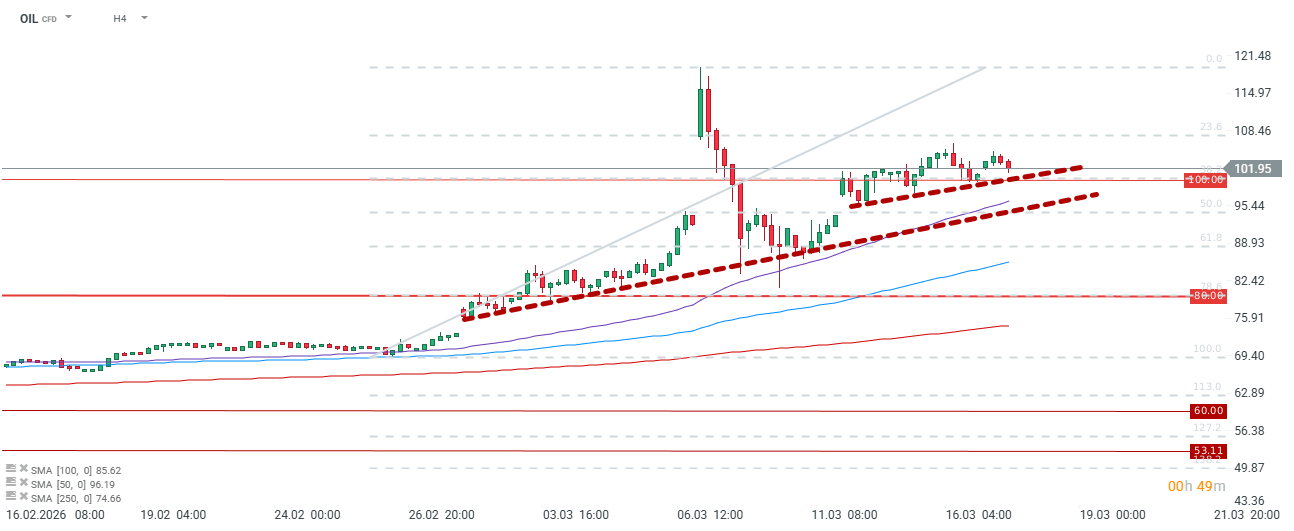
Comparison to 2022: The current backdrop echoes the 2022 energy shock, though supply risks now appear more acute. Key short-term support for Brent sits at $100 and $95. Source: xStation5
Gold
- Safe-Haven Struggle: Despite extreme geopolitical tension, gold remains pegged near $5,000 per ounce. Its lack of upward momentum reflects fears that looming inflation will trigger further interest rate hikes.
- Monetary Headwinds: Gold typically serves as an inflation hedge during periods of low-to-moderate price growth. Sharp spikes in consumer prices often provoke hawkish central bank pivots, which increase the opportunity cost of holding non-yielding bullion.
- The Dollar Factor: Unlike the 1970s/80s rallies, which were fueled by a collapsing greenback, the US Dollar is currently strengthening as a preferred reserve asset.
- Central Bank Activity: Long-term support remains anchored by central bank purchases, which have been aggressive since 2022. If the oil crisis proves transitory, a return to rate cuts could reignite the rally.
- Contrarian Views: While Robert Kiyosaki forecasts gold at $35,000 within a year, analysts remain cautious given his history of hyperbole and inaccurate Bitcoin projections.
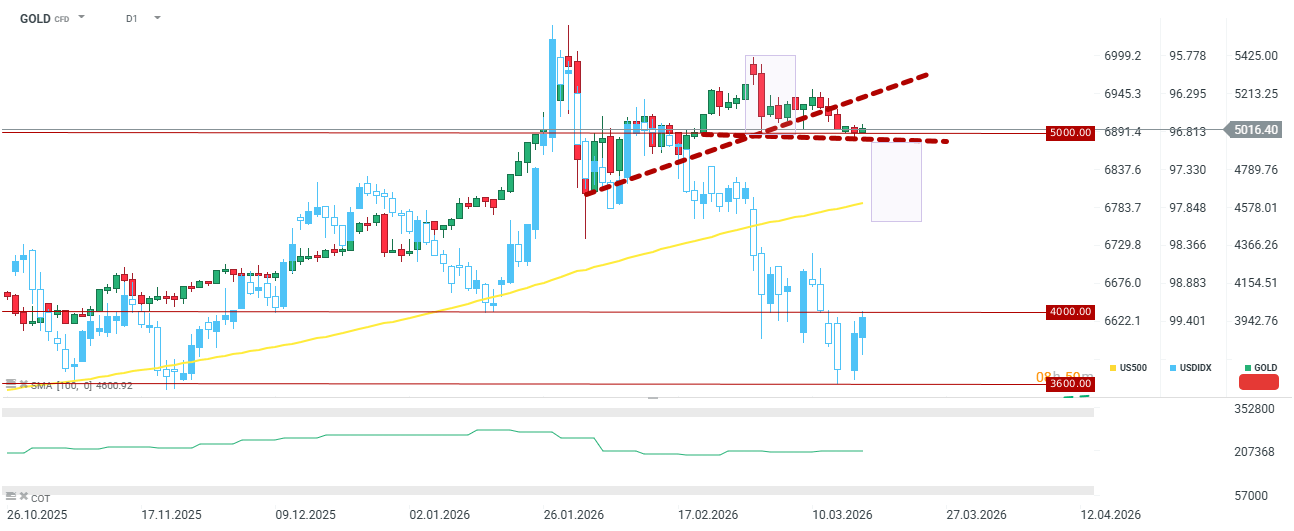
Technical Outlook: Gold is testing a critical juncture above $5,000. A break below the trend line could trigger a correction toward the $4,500 level. Source: xStation5
Silver
- Price Consolidation: Silver is stabilizing above $80 per ounce. Gains are capped by uncertainty regarding the duration of restrictive monetary policies.
- 2026 Outlook: A market deficit is expected for 2026, though it may be the narrowest in years due to weakening industrial and jewellery demand.
- Supply Dynamics: High prices are expected to drive a 7% YoY increase in silver recycling, potentially pushing global supply toward all-time highs.
- Inventory Watch: COMEX inventories are in steady decline, with registered stocks falling toward the 80m ounce mark.
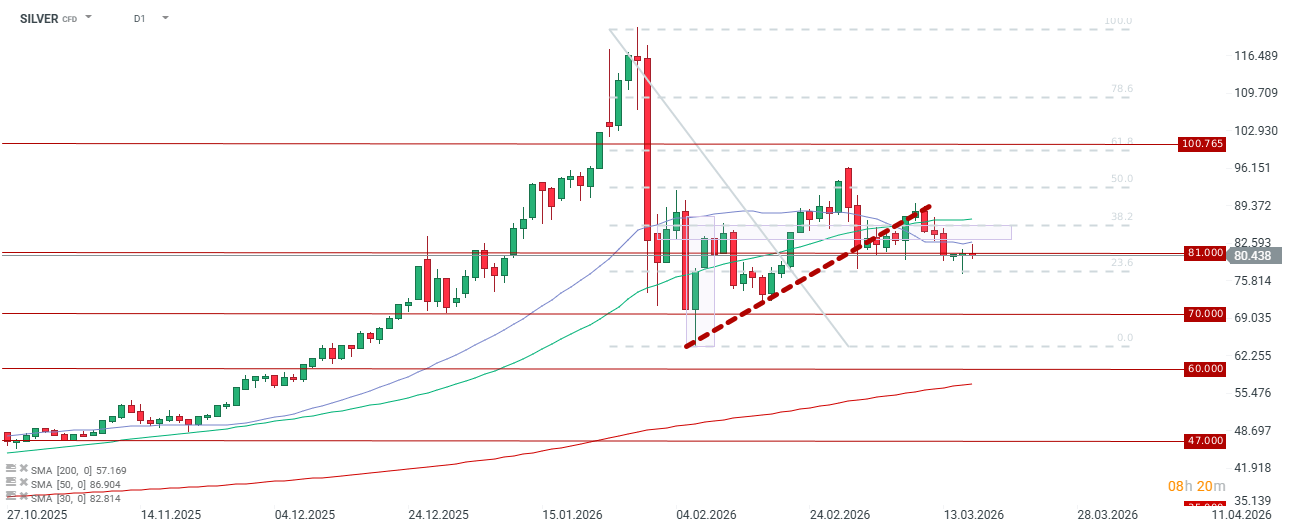
Technical Indicators: A bearish signal recently emerged as the 30-period moving average crossed below the 50-period average. Support holds at $80. Source: xStation5
Wheat
- Bearish Fundamentals: Global wheat markets remain fundamentally soft. The March USDA WASDE report left global balances largely unchanged.
- Stock Recovery: After five seasons of decline, the 2025/26 season is expected to see a rebound in global inventories, though 2026/27 remains vulnerable to weather and geopolitics.
- Crop Conditions: Winter wheat crops in the US and Europe are in good condition. Recent price volatility is attributed more to short covering and “risk-off” sentiment than structural shortages.
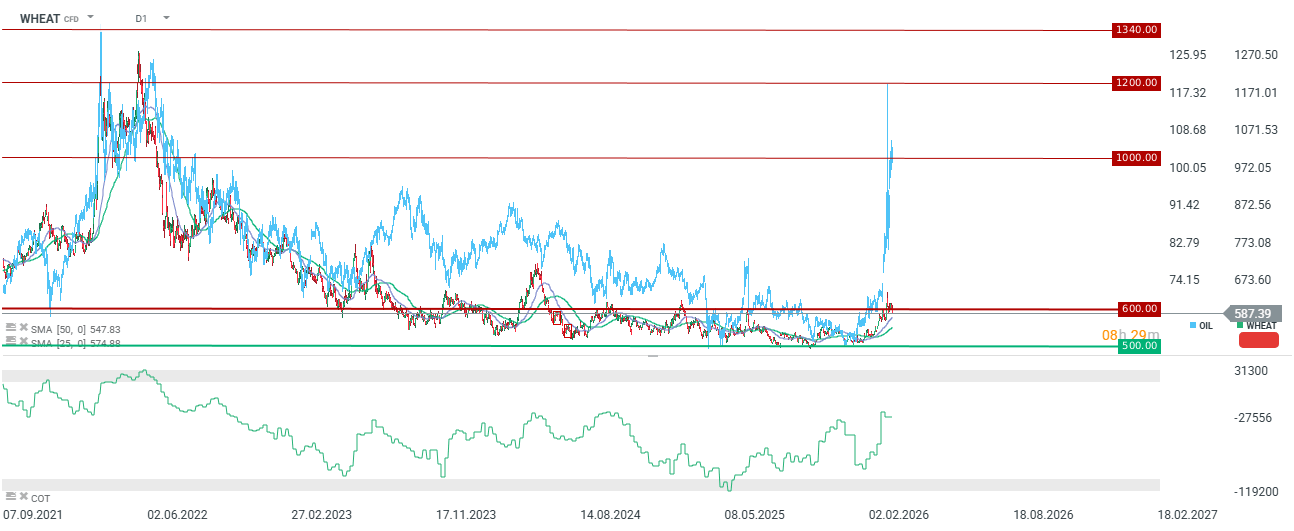
The Oil Correlation: Wheat remains sensitive to energy costs, particularly fuel and fertilizer. While prices retreated below 600 cents in mid-March, high oil prices pose a persistent upside risk. Source: xStation5
The material on this page does not constitute financial advice and does not take into account your level of understanding, investment objectives, financial situation or any other specific needs. All information provided, including opinions, market research, mathematical results and technical analyzes published on the Website or transmitted To you by other means, it is provided for information purposes only and should in no way be construed as an offer or solicitation for a transaction in any financial instrument, nor should the information provided be construed as advice of a legal or financial nature on which any investment decisions you make should be based exclusively To your level of understanding, investment objectives, financial situation, or other specific needs, any decision to act on the information published on the Website or sent to you by other means is entirely at your own risk if you In doubt or unsure about your understanding of a particular product, instrument, service or transaction, you should seek professional or legal advice before trading. Investing in CFDs carries a high level of risk, as they are leveraged products and have small movements Often the market can result in much larger movements in the value of your investment, and this can work against you or in your favor. Please ensure you fully understand the risks involved, taking into account investments objectives and level of experience, before trading and, if necessary, seek independent advice.