Prices retreat 3% to multi-month lows ahead of critical grinding data from Europe, Asia, and North America.
While global cocoa prices have retreated significantly from their 2024 record peaks, the chocolate industry remains mired in difficulty. Global demand shows signs of structural weakness, and processors are struggling to maintain profitability while working through historically expensive inventories.
A Sharp Price Correction Since hitting all-time highs in December 2024, cocoa futures have lost more than half of their value. Recent volatility has intensified, partly due to the rebalancing of commodity indexes. Although a short-term influx of capital into the futures market was expected, funds likely spread their exposure over a longer period. Today, prices are down over 3%, briefly dipping below the $5,000 per ton mark—the lowest level since late November. Despite this significant sell-off, the commodity remains expensive by historical standards, with prices still substantially higher than those seen four to five years ago.
Demand Destruction Hits Processing The primary headwind for a price recovery is so-called “demand destruction”. Last year’s record prices forced consumers to rein in chocolate purchases and prompted manufacturers to reformulate recipes, opting for cheaper substitutes and increased fillers, such as nuts.
These effects are evident in cocoa grinding data—a key proxy for demand:
- Europe: Fourth-quarter 2025 grindings are estimated to have fallen roughly 3% year-on-year
- Asia: The region is expected to see the steepest decline, estimated at approximately 12%.
- North America: The only region projected to see a slight increase (+1.2%), primarily due to the addition of two new processing plants.
European data will be released on the morning of January 15, followed by U.S. figures later that afternoon (CET). Asian data is due on Friday, January 16. Given the downbeat expectations, markets appear to be pricing in the weakness ahead of the official releases. Experts note that European processing margins fell below break-even as early as August and hit record lows in December, forcing firms to curb investment and production rates.
Crisis at the Source: Ivory Coast The price slump in New York and London has triggered a crisis for the world’s top producer, Ivory Coast. Local exporters are caught in a pincer move between state-mandated farmgate prices and tumbling international benchmarks.
The current situation is critical:
- The farmgate price stands at 2,800 CFA francs per kilogram (approx. $4.97).
- With market prices hovering around $5,000 per ton, exporter margins have effectively vanished, leading to liquidity issues and port congestion.
Traders are appealing to the government for subsidies or tax relief to sustain purchases from farmers. However, the industry regulator (CCC) has categorically rejected proposals to lower the farmgate price.
When Will Relief Reach Retail Shelves? Despite the collapse in raw material costs, consumers should not expect immediate price cuts for confectionery. Most beans processed in Q4 2025 were purchased before the sharp price decline. Market observers predict that retail price relief will only manifest in the second half of 2026. Until then, thin margins and underutilized capacity will continue to weigh on the global cocoa market. Furthermore, it is widely believed that the ultra-low prices seen during the pandemic era are unlikely to return.
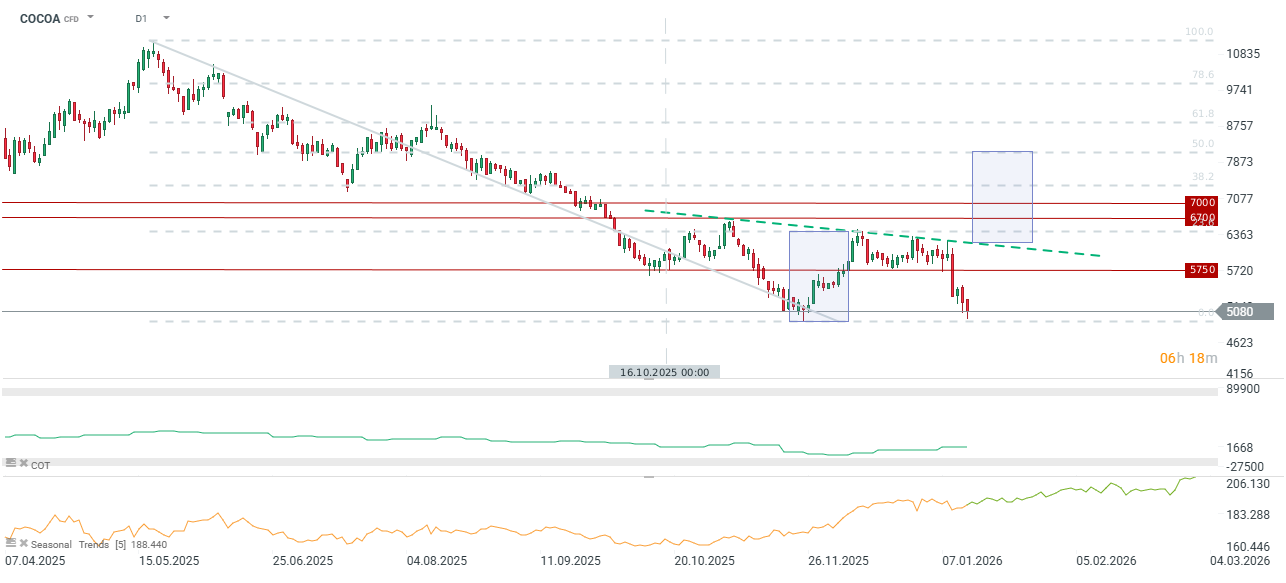
Technical Outlook Prices have dropped toward the $5,000 level, effectively invalidating a potential inverse Head and Shoulders (oRGR) formation. However, if the price holds above November lows, a double-bottom formation could emerge, with a neckline near $6,300. It remains possible that weak grinding data could act as a contrarian catalyst, similar to the price action seen in October, when the market saw a temporary upward correction within a long-term bearish trend.
The material on this page does not constitute financial advice and does not take into account your level of understanding, investment objectives, financial situation or any other specific needs. All information provided, including opinions, market research, mathematical results and technical analyzes published on the Website or transmitted To you by other means, it is provided for information purposes only and should in no way be construed as an offer or solicitation for a transaction in any financial instrument, nor should the information provided be construed as advice of a legal or financial nature on which any investment decisions you make should be based exclusively To your level of understanding, investment objectives, financial situation, or other specific needs, any decision to act on the information published on the Website or sent to you by other means is entirely at your own risk if you In doubt or unsure about your understanding of a particular product, instrument, service or transaction, you should seek professional or legal advice before trading. Investing in CFDs carries a high level of risk, as they are leveraged products and have small movements Often the market can result in much larger movements in the value of your investment, and this can work against you or in your favor. Please ensure you fully understand the risks involved, taking into account investments objectives and level of experience, before trading and, if necessary, seek independent advice.