Chubb to Insure Ships Crossing The Strait of Hormuz

US insurance giant Chubb (CB.US) has been designated as the lead insurer in a program supported by the U.S. International Development Finance Corporation (DFC) aimed at restoring commercial shipping through the Strait of Hormuz amid elevated risks linked to the war with Iran. The program includes a reinsurance mechanism of up to $20 billion designed to cover potential war-related damages.
- The insurance program covers ship hulls, machinery, and transported cargo, as well as environmental damages, such as the costs of cleaning up potential oil spills. Chubb will provide direct insurance to shipowners and coordinate information related to vessels and cargo moving through the region.
- The initiative is intended to reduce the paralysis in regional shipping. Under normal conditions, around 15 million barrels of crude oil and about 5 million barrels of refined petroleum products pass through the Strait of Hormuz daily. However, since the outbreak of the conflict, tanker traffic has declined significantly due to the risk of attacks.
- In recent days, further security incidents have occurred. According to UK Maritime Trade Operations, three vessels off the coast of Iran were struck by projectiles, confirming the persistently high operational risk for shipping companies.
- The Strait of Hormuz remains a critical global oil market “choke point,” connecting the Persian Gulf with the Arabian Sea and serving as the primary maritime export route for energy resources from the region.
- The Donald Trump administration has signaled the possibility of further military action if Iran attempts to block shipments through the strait. In the event of a prolonged conflict, the US Navy may also escort oil tankers transiting the waterway.
- Analysts note that restoring stable trade flows will likely require both military protection of shipping routes and insurance mechanisms that reduce financial risk for shipowners and logistics operators.
- Evan Greenberg, Chairman and CEO of Chubb (CB.US), said the company is proud to lead the program in partnership with the US government and the U.S. International Development Finance Corporation, emphasizing that commerce passing through the Strait of Hormuz plays a vital role in the global economy and that providing insurance protection to vessels is essential for restoring trade flows.
- In its 2025 results, Chubb reported record property and casualty underwriting income of $6.53 billion, representing an 11.6% year-over-year increase. At the same time, the company recorded a combined ratio of 85.7%, reflecting very strong underwriting profitability.
Why this could be a business opportunit
- Higher insurance premiums: During wartime, so-called war-risk insurance for tankers can rise several-fold or even more.
- Large market scale: Around 20 million barrels of oil and petroleum products normally pass through the Strait of Hormuz each day, creating a substantial potential market for insurance coverage.
- Lead underwriter position: Chubb becomes the central player in the program, strengthening its position in the global marine and energy insurance market.
- Relationship with the US government: Cooperation with the DFC may lead to additional contracts tied to infrastructure and energy projects.
Why it may not translate into huge profits in the short term
- State-backed reinsurance: Up to $20 billion of coverage is provided by the DFC, meaning part of the risk and margins are regulated and cannot simply be increased.
- High catastrophe risk: For example, the sinking of a VLCC supertanker could result in multi-billion-dollar losses (cargo, vessel, environmental damage).
- Risk sharing: Insurers typically distribute exposure through syndicates, meaning Chubb will not bear the entire risk alone.
Ultimately, the biggest value may lie not only in immediate profit but in potential long-term dominance in the war-risk shipping insurance market, access to data on global oil trade flows, and strengthening its reputation as an insurer of strategic infrastructure.
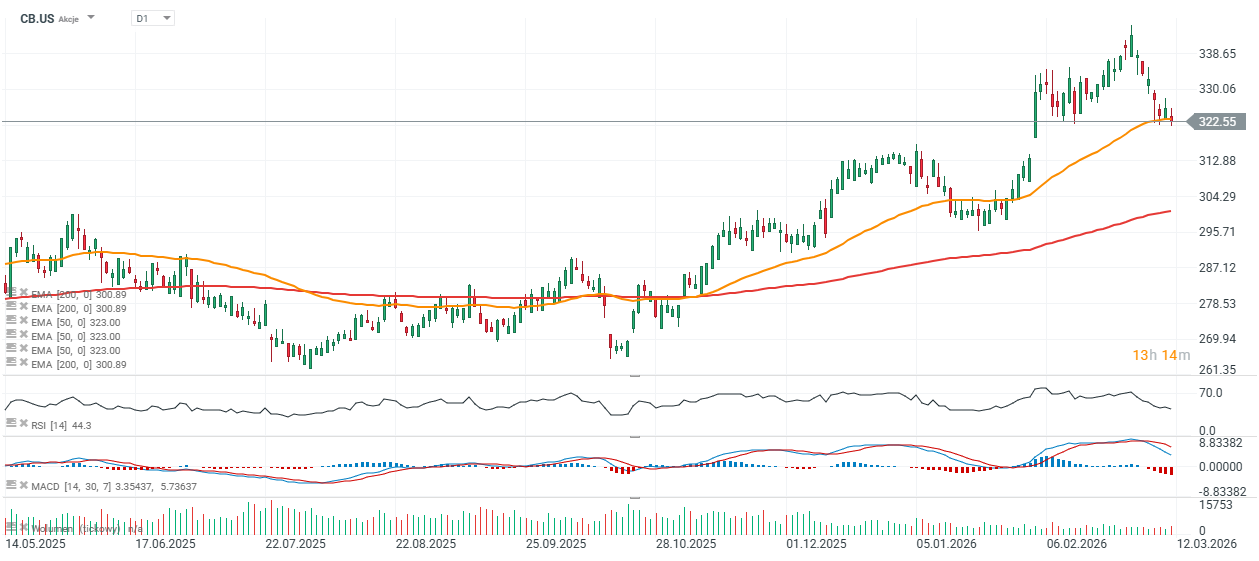
Chubb stock (D1)
Chubb shares have not reacted with gains to the news of the government contract. Investors may be concerned that the company is taking on risks that could be difficult to monetize. On the other hand, over the long term the contract could prove highly beneficial for the company—particularly if no catastrophic incident occurs involving vessels insured by Chubb.
Source: xStation5
The material on this page does not constitute financial advice and does not take into account your level of understanding, investment objectives, financial situation or any other specific needs. All information provided, including opinions, market research, mathematical results and technical analyzes published on the Website or transmitted To you by other means, it is provided for information purposes only and should in no way be construed as an offer or solicitation for a transaction in any financial instrument, nor should the information provided be construed as advice of a legal or financial nature on which any investment decisions you make should be based exclusively To your level of understanding, investment objectives, financial situation, or other specific needs, any decision to act on the information published on the Website or sent to you by other means is entirely at your own risk if you In doubt or unsure about your understanding of a particular product, instrument, service or transaction, you should seek professional or legal advice before trading. Investing in CFDs carries a high level of risk, as they are leveraged products and have small movements Often the market can result in much larger movements in the value of your investment, and this can work against you or in your favor. Please ensure you fully understand the risks involved, taking into account investments objectives and level of experience, before trading and, if necessary, seek independent advice.