The Reserve Bank of Australia raised its interest rate by 25 basis points to 4.10% at today’s meeting, in line with widespread market expectations. The decision was made by a relatively close 5-4 vote among Monetary Policy Board members, indicating a close split on the necessity of the hike. Governor Michele Bullock explained during a press conference that the split in the vote concerned only the timing of the decision, not the direction of monetary policy. She emphasized that all Board members agreed that inflation is too high and that the current interest rate is not high enough to bring it back to the 2–3% inflation target. Bullock noted that higher fuel prices linked to the conflict in the Middle East could further fuel inflationary pressures, but were not the main reason for today’s hike. The Monetary Policy Council warned that the risk of inflation remaining above target has increased and shifted upward, requiring vigilance regarding incoming data. It was emphasized that further policy tightening will depend on the evolution of the economic situation, including households’ reaction to the two rate hikes to date and the development of the conflict in the Middle East.
The foreign exchange market reacted immediately to the decision, triggering a so-called whipsaw in the AUD/USD pair, which first broke above 0.7084 and then fell to around 0.7060–0.7070. Following Governor Bullock’s remarks, which eased concerns about the path of future rate hikes, AUD/USD rebounded to around 0.7075, posting a 0.1% gain for the day. Analysts note that the Australian dollar traditionally benefits from the interest rate differential against the U.S. dollar, and the current rate hike increases the attractiveness of AUD-denominated assets. Market expectations for another hike in May are priced in at around 38%, while a full 25-basis-point hike is priced in for August 2026. Many economists and major Australian banks forecast that the interest rate could reach 4.35% by the end of the year if inflationary pressures persist. However, ongoing uncertainty related to the conflict in the Middle East and oil price volatility could delay further tightening, causing the market to remain cautious about the pace of future hikes.
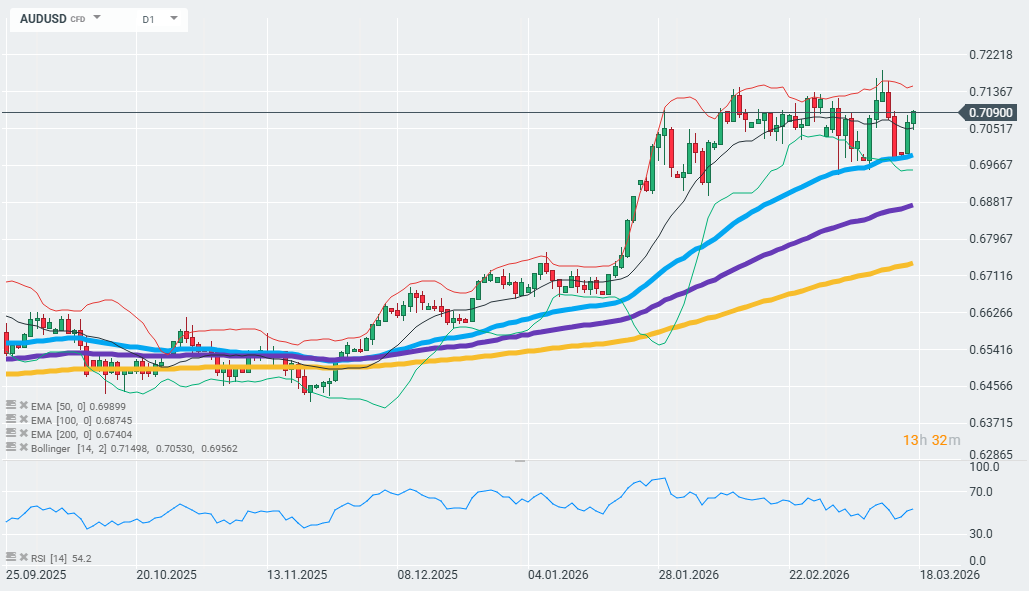
Technically, the AUD/USD pair has held key support around 0.7040 (the 50-day EMA), a break below which could pave the way for further declines toward 0.7000. However, as long as expectations of additional rate hikes in Australia persist, the pair is supported by demand related to capital flows in search of higher returns and the aforementioned 50-day moving average.
The material on this page does not constitute financial advice and does not take into account your level of understanding, investment objectives, financial situation or any other specific needs. All information provided, including opinions, market research, mathematical results and technical analyzes published on the Website or transmitted To you by other means, it is provided for information purposes only and should in no way be construed as an offer or solicitation for a transaction in any financial instrument, nor should the information provided be construed as advice of a legal or financial nature on which any investment decisions you make should be based exclusively To your level of understanding, investment objectives, financial situation, or other specific needs, any decision to act on the information published on the Website or sent to you by other means is entirely at your own risk if you In doubt or unsure about your understanding of a particular product, instrument, service or transaction, you should seek professional or legal advice before trading. Investing in CFDs carries a high level of risk, as they are leveraged products and have small movements Often the market can result in much larger movements in the value of your investment, and this can work against you or in your favor. Please ensure you fully understand the risks involved, taking into account investments objectives and level of experience, before trading and, if necessary, seek independent advice.



