Meta Platforms (META.US) has announced a five-year program to purchase AMD-based AI infrastructure totaling 6 gigawatts, set to begin in the second half of 2026. This is one of the largest AI infrastructure deals of the current capex cycle and a meaningful confirmation that Advanced Micro Devices is moving into the “tier-1” hyperscaler supplier group alongside Nvidia—AMD shares are up more than 14% in US pre-market trading on the headline. In recent weeks, companies benefiting from the infrastructure buildout of AI have clearly outperformed the software segment.
On the back of the agreement, Meta has committed to buying more than $100 billion worth of AI compute from AMD, securing up to 6 GW of capacity over five years and potentially building a roughly 10% stake in AMD. The deal strengthens AMD’s position versus Nvidia in the rapidly expanding AI chip market and includes custom AI chips as well as equity warrants linked to AMD’s future share-price performance. This is part of Mark Zuckerberg’s broader AI strategy: Meta is rapidly expanding data-center capacity and diversifying suppliers, with AI infrastructure spending expected to reach as much as $135 billion this year.
AMD emerges as a major AI beneficiary
- According to AMD CEO Lisa Su, the total value of the transaction series is expected to amount to “double-digit billions” of dollars per gigawatt, implying Meta’s multi-year capex for this specific program could run into tens of billions—or potentially above $100 billion—depending on the final configuration and hardware mix.
- The deal structure goes beyond a standard supply contract: Meta will receive warrants to purchase 160 million AMD shares, vesting in stages subject to project milestones and share-price conditions. If exercised, these warrants could make Meta a significant shareholder, underscoring that both parties are positioning the relationship as a long-term strategic partnership.
- Markets responded immediately and positively, with AMD surging in pre-market trading. The move reflects expectations for a material “step-up” in AI-related revenues and improving credibility for AMD in the accelerator segment. Meta shares rose only modestly, suggesting investors view the deal as consistent with its previously communicated compute-scale strategy rather than an unexpected increase in risk.
- Meta’s rationale is clear: the components will be customized to its needs, and the company will gain influence over the roadmap and design of future chip generations. From a total cost of ownership (TCO) and inference-efficiency perspective, this “co-design” model can be critical for optimizing power consumption and cost per token/task.
- Comments from Santosh Janardhan, Meta’s Head of Global Infrastructure, indicate AMD’s hardware is expected to support primarily inference—the deployment phase of trained models into production. This is an area where high energy efficiency and predictable capacity availability tend to matter more than peak training performance.
- Meta is reaffirming a multi-sourcing approach: it will continue developing its own in-house AI chips, maintain purchases from Nvidia, and add AMD to the mix. In practice, this signals that hyperscalers treat accelerators as a strategic resource rather than a commodity, and are actively diversifying supply-chain and vendor-dependence risk.
- For AMD, this is not only about volume but also a reputational inflection point: Meta is already AMD’s second-largest customer, and the new agreement could become a major growth driver in the coming years. Given AMD’s scale (around $34.6 billion of revenue last year), even an additional low double-digit billions of annual sales over the deployment horizon would materially alter AMD’s trajectory in the accelerator market.
- Overall, the structure and scale of the partnership suggest Meta and AMD are underwriting a scenario in which hyperscaler AI monetization translates into a multi-year investment supercycle—despite growing debate about the risk of an AI capex “bubble.”
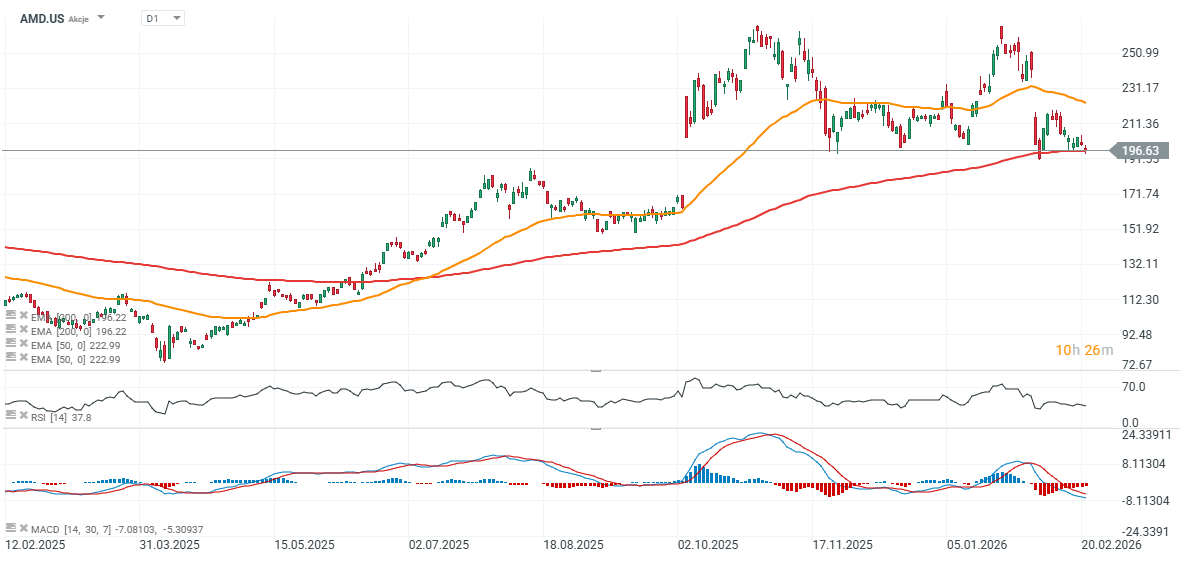
AMD.US (D1 timeframe)
AMD shares have recently fallen nearly 25% from the highs and are now testing the ~$191 area (EMA200). The Meta agreement appears to provide near-term relief and helps re-anchor the stock to a fundamentally supported uptrend.
Source: xStation5
The material on this page does not constitute financial advice and does not take into account your level of understanding, investment objectives, financial situation or any other specific needs. All information provided, including opinions, market research, mathematical results and technical analyzes published on the Website or transmitted To you by other means, it is provided for information purposes only and should in no way be construed as an offer or solicitation for a transaction in any financial instrument, nor should the information provided be construed as advice of a legal or financial nature on which any investment decisions you make should be based exclusively To your level of understanding, investment objectives, financial situation, or other specific needs, any decision to act on the information published on the Website or sent to you by other means is entirely at your own risk if you In doubt or unsure about your understanding of a particular product, instrument, service or transaction, you should seek professional or legal advice before trading. Investing in CFDs carries a high level of risk, as they are leveraged products and have small movements Often the market can result in much larger movements in the value of your investment, and this can work against you or in your favor. Please ensure you fully understand the risks involved, taking into account investments objectives and level of experience, before trading and, if necessary, seek independent advice.